
Employers are increasingly prioritising professionals with four to 10 years of experience.

Credit card adoption is rapidly expanding beyond India's major metropolitan areas into Tier-II and Tier-III cities, driven by increasing incomes, digital awareness, and the integration of RuPay credit cards with UPI, according to a new report by SBI Card.

India's top cement producers delivered a solid July-September quarter (Q2) in 2025-26 (FY26), lifted by firmer prices, higher sales volumes, and a favourable base. Seasonal weakness and maintenance outages did dent sequential performance, but the overall picture remained positive - and the road ahead looks steady.

Most active traders prefer mobile applications that provide real-time alerts, including price targets -- functions that dealers once delivered through client calls.

India's consumption stocks, which have outperformed the broader market, are now facing significant pressure due to a gradual rise in fuel prices and the potential for higher inflation. Analysts warn that companies may be forced to pass on increased input costs to consumers, potentially hurting demand across both staples and discretionary categories, with a looming threat of deficient monsoon rainfall further exacerbating inflationary concerns.

The Reserve Bank of India's (RBI's) state of the economy report observed that any durable alignment of headline retail inflation with the target of 4 per cent could recommence in the second half of FY25 and sustain until numbers closer to the target are seen during the course of FY26, dashing hopes of any reduction in the policy repo rate in the current financial year. The report, authored by RBI staffers, including Deputy Governor in charge of monetary policy Michael Patra, said though headline numbers may fall in July and August due to base effect, it is likely to reverse in September.

They accounted for 39.1 per cent of the premium paid to trade equity options in September 2025.

Wholesale price inflation (WPI) came in at (-) 0.32 per cent in November, driven by an uptick in prices of food articles like pulses and vegetables on a month-on-month basis, government data showed on Monday.
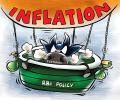
The Reserve Bank on Wednesday lowered the inflation projection for the current fiscal to 4 per cent from 4.2 per cent earlier, taking into account good agricultural output and falling crude prices.
Retail inflation rose to a three-month high of 1.33 per cent in December 2025 mainly due to higher prices of kitchen essentials, including vegetables and protein-rich items.

Overall economic activity continued to hold up in November with demand conditions remaining robust, thanks to strengthening urban demand, but manufacturing and rural demand showed some signs of deceleration even as services remained strong, according to an article on the State of the Economy written by Reserve Bank of India (RBI) officials in the central bank's December bulletin.

Retail inflation slipped to 1.54 per cent in September from 2.07 per cent in the preceding month mainly due to subdued prices of food items, including vegetables and pulses, according to government data released on Monday. The consumer price index (CPI) based inflation was 5.49 per cent in September 2024.
India's consumer price index (CPI)-based retail inflation rate is likely to have cooled further in June, thus remaining below the 4 per cent target of the Reserve Bank of India (RBI) for a fifth consecutive month, giving the central bank wiggle room to focus on growth. Economists reckon that the decline is on account of easing prices in various categories of goods, especially food items, and a favourable base effect.

Stocks of brokerages and market infrastructure institutions (MIIs) witnessed selling pressure after the Securities and Exchange Board of India's (Sebi's) crackdown on proprietary trading firm Jane Street. The weakness was attributed to concerns that debarment of the US firm - a prominent player in the futures and options (F&O) segment - will lead to a further decline in volumes, which are already down over 30 per cent from the peak.

Retail inflation eased to a nearly six-year low of 3.16 per cent in April mainly due to subdued prices of vegetables, fruits, pulses, and other protein-rich items, creating enough room for the Reserve Bank to go for another round of rate cut in the June monetary policy review. The Consumer Price Index (CPI) based inflation was 3.34 per cent in March and 4.83 per cent in April 2024. It was 3.15 per cent in July 2019.

Indian economy to grow at 6.3-6.8 pc in FY26, against 6.4 pc in FY25

In a significant policy shift aimed at boosting agri-productivity and rural prosperity, Finance Minister Nirmala Sitharaman on Saturday announced six new agricultural schemes while increasing the subsidised Kisan Credit Card loan limit to Rs 5 lakh from the existing Rs 3 lakh, benefiting 7.7 crore farmers, fishermen, and dairy farmers.

"The new structure will substantially reduce taxes on the middle class and leave more money in their hands, boosting household consumption, savings and investment," Sitharaman said presenting what was dubbed as 'reformist' budget for the next fiscal in Lok Sabha.
The country's largest private sector lender HDFC Bank on Saturday said it will grow its loan book slower than the industry in the current financial year (FY25). The move comes as the lender looks to bring down its elevated credit - deposit (CD) ratio to pre-merger levels. "We will bring down the CD ratio faster than what we had anticipated.

Union Finance Minister Nirmala Sitharaman on Monday said people are finding current interest rates "very stressful" and urged banks to make them affordable. Speaking at an event organised by State Bank of India, the finance minister said that at present, India requires industry to ramp up and invest in new facilities, and added that lowering lending rates can help achieve the "Viksit Bharat" aspiration.

Existing optimism about the capital goods sector has been enhanced by the Assembly election results, which were favourable for the BJP. The prospects of political continuity led to renewed interest in the sector. There are demand-supply gaps, especially in power, and visibility of improved pricing and strong order flows, including from private enterprises.
